5G Internet in Australia: A Comprehensive Overview
5G, the fifth generation of mobile network technology, represents a significant advancement in wireless communication infrastructure across Australia. This page provides an objective, detailed examination of 5G networks, their implementation in Australia, and what this means for consumers and businesses nationwide.
Since commercial rollout began in 2019, 5G networks have been expanding steadily across Australian cities, regional centers, and select rural areas. The technology promises faster download speeds, lower latency, and greater network capacity compared to previous generations of mobile networks.
What is 5G?
5G stands for the fifth generation of mobile network technology, following 1G, 2G, 3G, and 4G. Each generation has brought improvements in speed, capacity, and functionality. 5G represents a fundamental shift in how mobile networks operate, enabling new applications and use cases that were not possible with previous technologies.
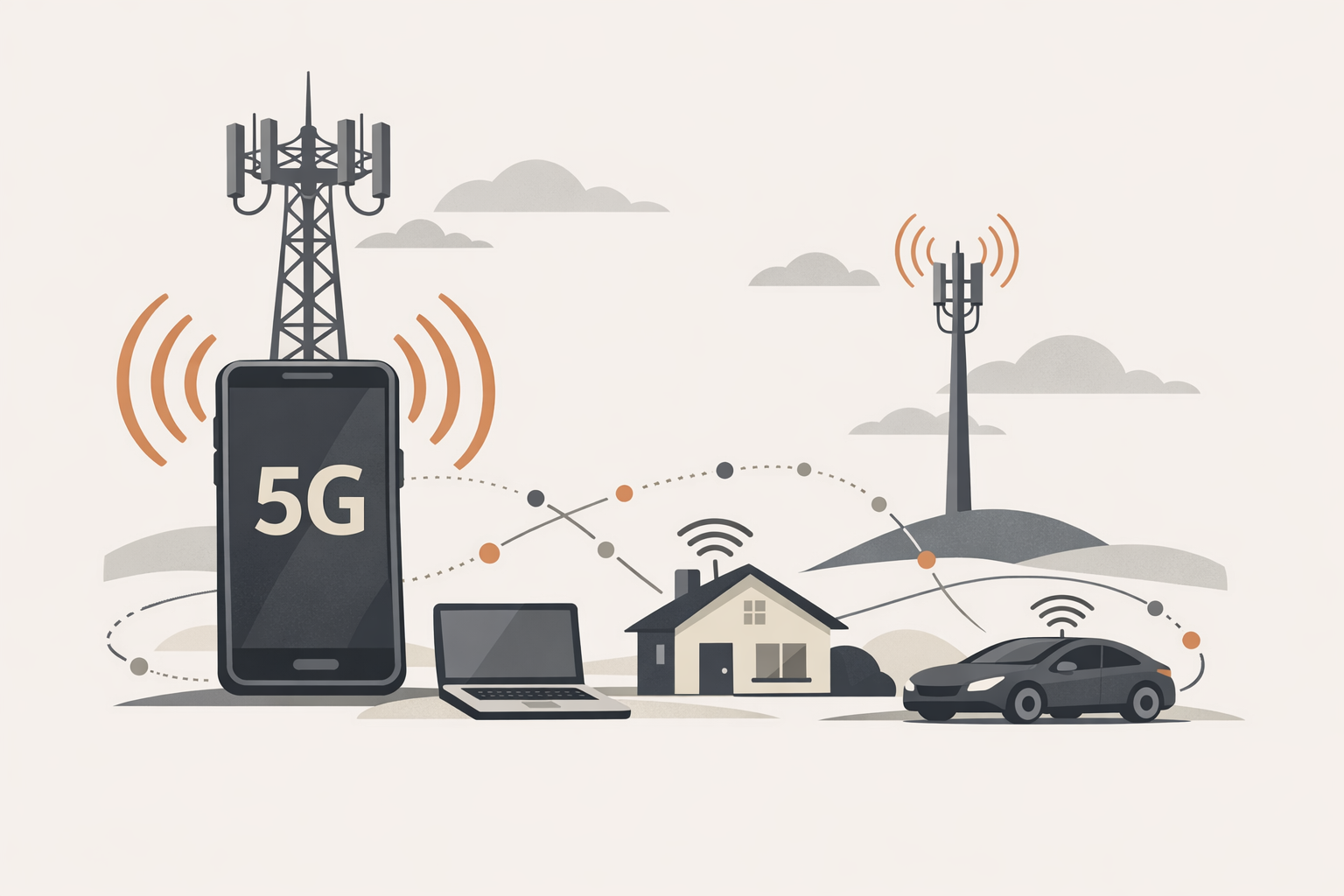
Key characteristics of 5G technology include:
- Faster Data Speeds: Theoretical peak speeds can reach up to 20 gigabits per second (Gbps), significantly higher than 4G's typical maximum of 1 Gbps
- Lower Latency: Response times as low as 1 millisecond, compared to approximately 30-50 milliseconds on 4G networks
- Greater Capacity: Ability to support many more connected devices simultaneously within the same geographic area
- Improved Reliability: More consistent connection quality with fewer dropped connections or interruptions
5G Implementation in Australia
Australia was among the early adopters of 5G technology globally. The Australian Communications and Media Authority (ACMA) allocated spectrum for 5G services in 2018, enabling telecommunications companies to begin network deployment.
The rollout of 5G networks in Australia has progressed through several phases:
2019-2020: Initial Deployment
Major Australian telecommunications providers launched their first 5G services in metropolitan areas, beginning with major cities including Sydney, Melbourne, Brisbane, Adelaide, and Perth. Initial coverage focused on high-density urban areas and central business districts.
2021-2022: Expansion Phase
Network providers expanded 5G coverage to suburban areas, regional cities, and major transport corridors. This phase saw significant infrastructure investment as providers upgraded existing cell sites and constructed new ones to support 5G technology.
2023-2024: Regional and Rural Reach
5G coverage extended to regional centers and selected rural areas. While comprehensive rural coverage remains an ongoing challenge, providers have made progress in bringing 5G services to regional towns and communities.
Current Status
As of 2024, 5G networks cover the majority of Australian metropolitan areas and many regional locations. Coverage continues to expand as infrastructure development progresses. However, coverage quality and availability vary significantly by location and service provider.
Evolution of Mobile Network Generations
1G (1980s)
Analog voice calls only. Introduced mobile phones to Australia. Limited capacity and poor voice quality. No data services available.
2G (1990s)
Digital technology with improved voice quality. Introduced SMS text messaging. Basic data services possible at very slow speeds.
3G (2000s)
Mobile internet became practical. Email, web browsing, and video calling became possible. Speeds up to 2 Mbps. Smartphones emerged.
4G/LTE (2010s)
High-speed mobile broadband. Streaming video, video conferencing, and online gaming became feasible. Speeds up to 1 Gbps. LTE-Advanced introduced.
5G (2020s-Present)
Ultra-fast speeds up to 20 Gbps. Ultra-low latency enabling real-time applications. Massive connectivity for IoT devices. Applications include autonomous vehicles, remote surgery, smart cities, and advanced industrial automation. Ongoing deployment across Australia.
5G Frequency Bands in Australia
5G networks in Australia utilize several frequency bands, each offering different characteristics in terms of coverage, capacity, and speed:
| Frequency Range | Type | Characteristics | Applications |
|---|---|---|---|
| 600 MHz - 900 MHz | Low-band | Excellent coverage, moderate speeds | Rural coverage, indoor penetration |
| 3.5 GHz - 3.8 GHz | Mid-band | Balanced coverage and capacity | Urban and suburban deployment |
| 26 GHz - 40 GHz | High-band (mmWave) | Limited range, highest speeds | Dense urban areas, specific venues |
Australian providers primarily use mid-band frequencies (3.5 GHz range) for most 5G deployments, offering a balance of coverage and performance. High-band mmWave frequencies are deployed in specific high-traffic locations such as stadiums and shopping centers.
Benefits and Considerations
Benefits of 5G Networks
- Enhanced Speed: Significantly faster download and upload speeds enable quicker file transfers, smoother streaming, and faster loading of web content
- Reduced Latency: Lower response times improve real-time applications such as video conferencing and online gaming
- Increased Capacity: Networks can handle more devices simultaneously, reducing congestion in busy areas
- Improved Reliability: More stable connections with fewer interruptions or dropped calls
- Future-Ready Infrastructure: Foundation for emerging technologies and applications
Considerations
- Device Compatibility: 5G-capable devices are required to access 5G networks. Older devices will continue to operate on 4G, 3G, or 2G networks where available
- Coverage Availability: 5G coverage is not yet universal. Availability depends on location and service provider
- Infrastructure Requirements: 5G networks require significant infrastructure investment and ongoing maintenance
- Environmental Factors: Signal strength can be affected by buildings, terrain, and weather conditions
Important Information
Users seeking information about health and safety aspects of 5G technology should refer to official resources from ARPANSA and the Australian Government Department of Health for authoritative information.
Explore Further
Coverage Map
Detailed information about 5G coverage across Australian states and territories.
View Coverage